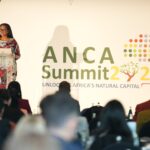
𝗖𝗮𝗽𝗲 𝗧𝗼𝘄𝗻 – 𝗟𝗲 𝗦𝗼𝗺𝗺𝗲𝘁 𝗔𝗡𝗖𝗔 𝟮𝟬𝟮𝟱 𝗲𝘀𝘁 𝗼𝗳𝗳𝗶𝗰𝗶𝗲𝗹𝗹𝗲𝗺𝗲𝗻𝘁 𝗹𝗮𝗻𝗰𝗲́.
October 7, 2025
𝐀𝐍𝐂𝐀 𝐒𝐮𝐦𝐦𝐢𝐭 𝟐𝟎𝟐𝟓 – 𝐔𝐧𝐞 𝐩𝐫𝐞𝐦𝐢𝐞̀𝐫𝐞 𝐣𝐨𝐮𝐫𝐧𝐞́𝐞 𝐭𝐨𝐮𝐫𝐧𝐞́𝐞 𝐥’𝐚𝐜𝐭𝐢𝐨𝐧 𝐞𝐭 𝐥𝐞𝐬 𝐬𝐨𝐥𝐮𝐭𝐢𝐨𝐧𝐬
October 8, 2025
Ladies and Gentlemen,
Ladies and Gentlemen, Distinguished Guests,
I’m delighted to be here this morning to share my views on a subject of great importance to Africa, Gabon, my country and myself: Nature.
So I’d like to say a big thank you to ANCA, FSD Africa and of course the lovely Dorothy Maseke for this honor.
Let me start by asking you a quick question: what is the link between the Sahara desert, the Ethiopian highlands and the Blue Nile? The answer is quite simple: it’s the Congo Basin forest. Science tells us that the Congo Basin feeds the atmospheric rivers responsible for rainfall in the Ethiopian highlands, which then flow into the Blue Nile. Similarly, it is the Congolese and Gabonese portions of this Congo Basin forest that generate the atmospheric rivers needed for rainfall in the much drier Sahel region. So, if we lose this forest, we’ll dry up the Blue Nile, we’ll lose agriculture in Ethiopia, we’ll cause famine in Egypt and rainfall in the Sahel will fall, encouraging its advance southwards across the continent. As a result, over 500 million Africans from East to West will be exposed to harsher living conditions.
Today, this forest is experiencing an annual deforestation rate of 650,000 ha. To give you a better idea of this volume, remember that 650,000 ha is a portion of land larger than the city of Brasilia, 2 times larger than Cape Town where we are today, or 4 times larger than London.
All this to say that preserving nature is no longer a choice, it’s an absolute necessity. And in Gabon, it’s part of our DNA, long before the fight against global warming became a hot topic, well before 1972 and the United Nations Conference on the Human Environment in Stockholm. Our ancestral traditions make the forest our natural habitat, our larder, our pharmacy, our source of knowledge, and so we are duty-bound to look after it for future generations.
Since our independence in 1960, Gabon has regularly translated this restraint towards commercial exploitation of the forest and its biodiversity into its legal corpus. This has, of course, enabled us to achieve extraordinary results in terms of biodiversity conservation: 88% of Gabon’s territory is covered by tropical forest, with a deforestation rate of less than 0.05%; our maritime coastline, over 800km long, is home to a rich marine fauna; we have a remarkable fauna (a 50% increase in the forest elephant population, whereas it has declined by 50% on the continent, over 30,000 silverback gorillas…) and an invaluable carbon sink….
But this has also been achieved at the cost of painful economic choices and painful renunciations, such as the halting of new onshore oil drilling despite the established presence of hydrocarbons.
Today, we refuse to choose between economic development and conservation. We need both to coexist. For nature conservation to be sustainable, it must respond to a simple, strong, sustainable and shared economic logic.
This is the underlying reason for the creation of the Agence Gabonaise pour le Développement de l’Économie Verte (AGADEV), which I have the honor of leading. Our role at AGADEV is to create this economic model with the private sector, thanks to international financing and for the benefit of the forest and the populations, first and foremost the local communities who conserve this forest.
AGADEV is the culmination of a process begun in 2009 with the ban on the export of raw logs, the obligation to exploit our forests sustainably, and the local transformation of our natural capital to capture more value for our country. Today, we need to go further and build a genuine bioeconomy based on the principle of circularity, biotechnology and bioprospecting. Our mission is therefore 4fold:
- Simplify our laws and regulations and bring them into line with international and/or business-friendly provisions (Nagoya Protocol, Special Investment Provisions, etc.).
- Create the tools and interfaces needed for dialogue with the private sector, funding agencies and local communities
- Identify investment opportunities, then build, structure and coordinate a pipeline of projects
- Raise financing for identified projects for both the state and the local private sector, but also co-invest alongside those seeking a local partner to de-risk their investments.
Ladies and gentlemen of the private sector looking for business opportunities, let me remind you that Gabon has over 7,500 species of plants, seeds, roots and bark, as well as a large number of microorganisms scattered throughout this forest. Our ancestral knowledge has revealed beneficial uses for some of them. We must now work to bring this knowledge to scale and disseminate it in a sustainable way. For the others, we are opening up our forest to fundamental and applied research to discover the products, medicines and materials of tomorrow.
To green finance professionals, we say “don’t hesitate any longer”. Gabon, the country with the lowest deforestation rate in the Congo Basin, has structured itself to receive and absorb your financing for resilient infrastructure in ecotourism, waste wood recovery and more…. We speak your language, so let’s sit down, talk and understand each other. We’re creative and open to structuring. Incidentally, I’d like to remind you that Gabon was the first African country to restructure its debt with a blue “debt-for-nature swap” bond in 2023.
Ladies and Gentlemen, Distinguished guests, I couldn’t end my speech without mentioning how proud I, the President of the Gabonese Republic and my entire country are to see the sister Republic of South Africa assume the presidency of the G20. I would therefore like to acknowledge its leadership on the continent’s economic issues, but also on issues specifically linked to the development of the bioeconomy. Thank you for representing us with dignity. Thank you for welcoming us here.
Finally, I’d like to turn once again to ANCA and highlight its incredible work to accelerate the financing of nature, with the forthcoming launch of the Bioeconomy Finance Hub. Thanks to Dorothy and her team for their dedication to nature in Africa. It was your passion that prompted us to join ANCA, and today we are happy and proud to have done so.
Thank you for listening, and if there’s only one thing you need to remember, please keep in mind that Gabon Forest is now open to sustainable business.
Thank you.”

